Most people who've heard of marma points assume they're an Ayurvedic version of acupressure — a map of the body with points you press, harder or softer depending on what you're after. That assumption gets the map roughly right and the method almost entirely wrong. The single most important thing to understand about marma therapy is that the points are not pressed. They're approached, gently enough that they open on their own.
That distinction — pressed versus enlivened — is the whole therapy in miniature, and it's worth spending a few minutes on where these points come from, what they actually are, and why the touch is so much lighter than almost anyone expects the first time they experience it.
The classical texts describe marma points as the junctions where muscle, vein, ligament, bone and joint meet — anatomical intersections, in other words, rather than arbitrary spots on a chart. Ayurveda holds that this is also where prana, the life force, tends to gather and concentrate, which is why these particular junctions were singled out from the hundreds of anatomical intersections in the body as worth a therapy of their own.
The word itself — marma — means hidden, or secret, which gives some sense of how these points were regarded: not obvious like a joint you can see move, but present and significant all the same, requiring real training to locate and work with properly. That word choice is doing real work — it signals that the value here was never in something visible or self-evident, but in knowledge that had to be transmitted carefully, point by point, from someone who already understood it.
The classical count is 107 marma points. Maharishi AyurVeda counts 108, adding a hundred and eighth: atma, the Self. It's a small addition in number, but not a small one in implication — it reflects the tradition's broader position that the body cannot be fully addressed as a purely physical system, separate from the awareness that inhabits it.
These points aren't distributed evenly or arbitrarily across the body. They cluster where the classical texts held that vulnerability and vitality were both concentrated — the head, the joints, the major junctions where the body's structural and energetic systems, in this framework, most directly overlap. Working with them is described as a distinct skill from general massage, which is part of why it carries its own certification at MERU rather than being treated as a variation on the other oil treatments.
The comparison to acupressure is understandable — both work with mapped points on the body, both have roots in ancient systems of medicine, both are given by hand rather than with instruments. But the resemblance is mostly at the surface. Marma points are, in general, larger areas than acupressure points, and are understood to influence the smaller points around them rather than sit alongside them as an equivalent, parallel system.
There's a useful, if imperfect, analogy in how each system talks about effect. Acupressure and acupuncture tend to describe a point being stimulated to produce a specific, targeted response — closer to pressing a switch. Marma therapy describes something closer to persuasion than activation: the point is approached in a way that allows it to release on its own terms, rather than being made to do anything. Whether or not that distinction maps cleanly onto how either system is actually practised in every tradition, it's the framing Maharishi AyurVeda works from, and it shows up directly in how light the touch is.
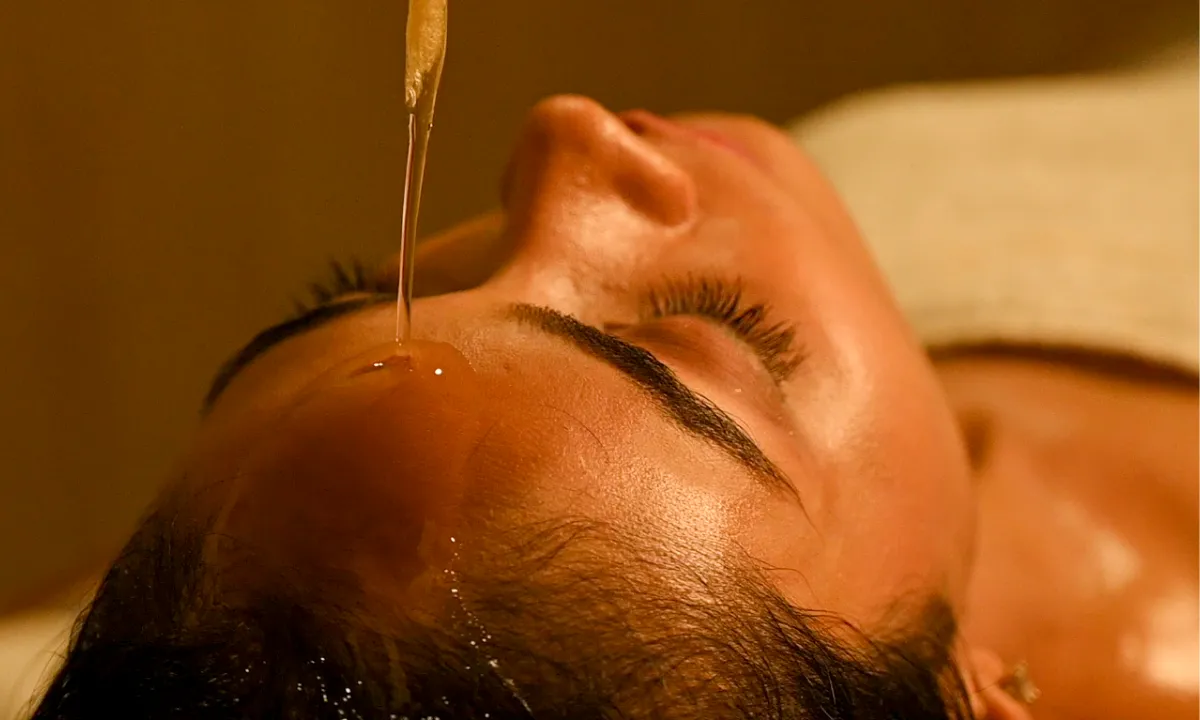
The real difference, though, is in the touch itself. Acupressure works by applying pressure to produce an effect — a firm, deliberate stimulation. Marma therapy works by doing close to the opposite: the practitioner approaches the point gently enough that it opens on its own, rather than being pressed into responding. Specific blends of essential oils are applied at each point as part of this, chosen for the person receiving the treatment, and the blend itself is understood to be part of what enlivens the point rather than a separate, secondary ingredient.
Most guests describe the same reaction the first time: it's lighter than they expected, sometimes lighter than they were braced for. That's not an incidental detail of the therapy. It's the method.
A Marma session runs about forty-five minutes, and the shape of it is quieter than most people expect from a therapy at all — there's no vigorous manipulation to watch for, no audible cracking or deep-tissue pressure to brace against. The practitioner works through a sequence of points relevant to what you're hoping to get from the session, using specific blends of essential oils chosen for you at each one.
The oils aren't incidental to the technique — they're understood as part of what allows the point to open rather than be pushed into responding. Which oil is used at which point, and in what sequence, is set by protocols built around your constitution and what you're hoping for from the session, rather than a single fixed routine applied the same way to everyone.
Because the therapy asks so little of the body in terms of physical pressure, it also asks very little recovery time afterward. There's no equivalent of the soreness that can follow a firmer massage, and no reason to build in extended rest the way you might after a more physically demanding treatment.

"Less pressure than you will believe until it is happening."
Marma therapy doesn't have a modern founder story, and it's worth explaining why, because two of the other Maharishi Signature Therapies do. Light Therapy with Gems was developed over thirty years by a named gemologist working under Maharishi's direct guidance — a genuinely new application, built from scratch in dialogue with the classical material. Marma is different: it's a classical practice thousands of years old, and what Maharishi AyurVeda did with it was restore and reframe it, not create it.
That's a meaningful distinction, and one worth stating plainly rather than blurring for the sake of a tidier story. The therapy's authority doesn't rest on who invented it recently — it rests on how faithfully the classical technique has been kept, and on the training the people giving it have actually done. At MERU, most of the treatment technicians hold the Marma certification, which means it's given by the same team that gives the oil treatments, rather than by a separate specialist brought in for this one thing.
There's one differentiator that does apply here, and it's arguably a stronger claim than a founder story would be, because it's something a guest can verify for themselves rather than take on trust: everyone who gives Marma therapy at MERU practises Transcendental Meditation. That isn't a general wellness-industry nod to mindfulness — it's written into the certification itself.
It's worth sitting with why that matters here specifically, rather than treating it as a generic credential. A therapy built around a very light, precise touch, meant to let a point open rather than force a response, depends heavily on the steadiness of the hands giving it — which is a different quality from strength or technique alone. The certification requirement isn't decorative. It reflects a view that the state of the person giving the treatment is part of what the treatment is.
One of three, not a whole-body treatment
Marma is given on its own, in a forty-five minute session, with protocols chosen for what you're hoping to get from it. It can also be added to a Panchakarma programme — a short, specific addition to a longer stay rather than a replacement for the classical oil treatments, which sit on a separate page of their own.
If you're deciding between Marma and the other two Signature Therapies — Aroma Therapy and Light Therapy with Gems — the simplest way to think about it is touch: Marma is the lightest touch of the three that still involves being touched at all. Aroma Therapy is mostly a conversation, and Light Therapy involves no touch whatsoever. If you're not sure which of the three actually suits what you're after, that's exactly the kind of question a short discovery call can settle in a few minutes, without any obligation attached to asking it.
Feel the difference for yourself
Forty-five minutes, booked directly online, with no consultation required first.
Continue reading
Signature Therapies · Vaidya Consultation · Ayurvedic Spa · Panchakarma