
What each one involves, how long it takes, what Ayurveda gives it for, and how you book it.
This page explains what each treatment is. The Ayurvedic Spa page is where you book one, and the Panchakarma page explains how they are sequenced into a programme.
The treatments fall into three groups, and the group tells you how you get one: the ones you book online and pick your own time for, the ones you book online and we confirm after a few questions, and the ones that are given inside a programme.
These are booked online, singly or in combination, with no consultation and no programme. You choose the treatment and the time, and it is confirmed straight away.
60 min · 2 therapists (1 also available)
The classical warm oil massage, given by two therapists moving in synchrony, in long rhythmic strokes. Unless your Vaidya has prescribed otherwise, the oil is Tridoshic, one that suits all three Doshas.
For: deep rest, circulation, and the nourishment of skin and tissue.
When: first, and often. It is the treatment the others are built on and the base of most combinations, on a programme it is given most days.
60 min · 2 therapists
A firmer, deeper treatment: more pressure, less oil, given by two therapists. A treatment in its own right rather than an addition to Abhyanga.
For: moving the deeper fluids, and loosening Ama, the residue Ayurveda describes as settling in the tissues.
When: on its own, or at the point in a programme where your tissues need movement rather than oleation.
30 min · 1 or 2 therapists
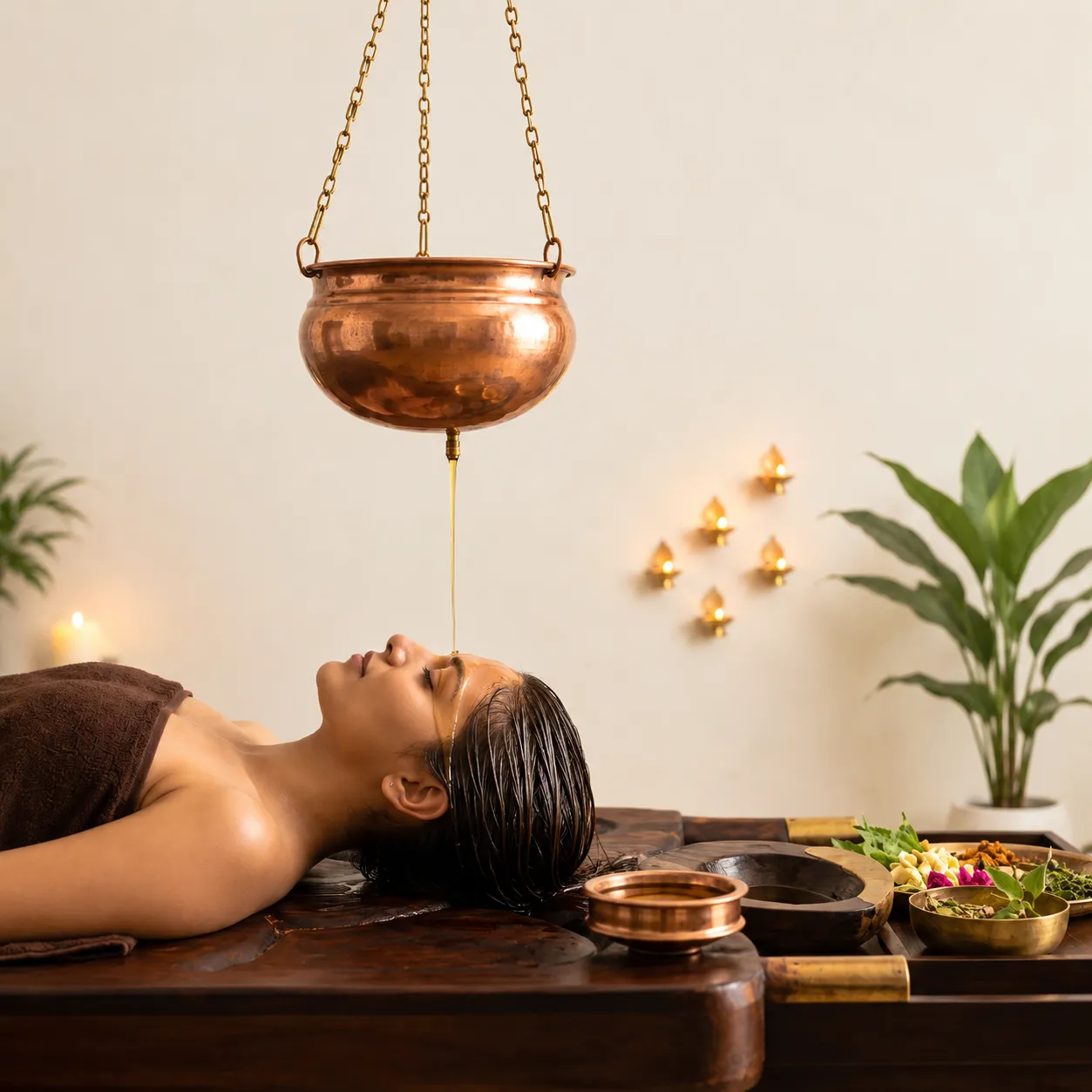
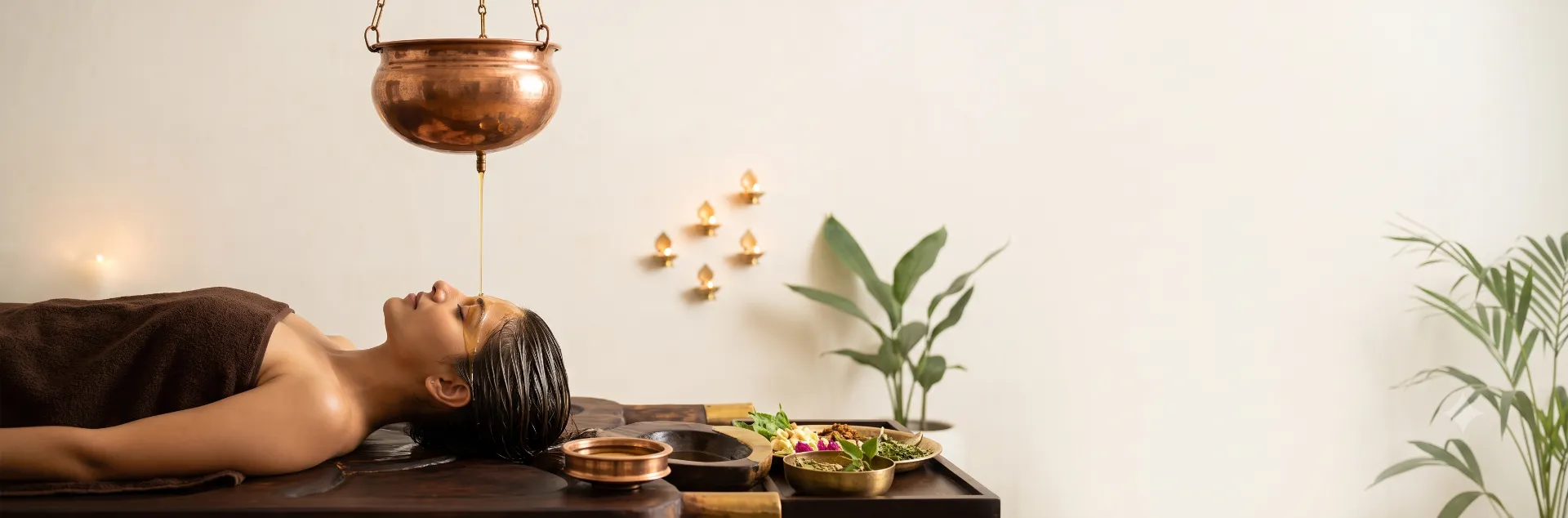
Warm herbal oil poured in a continuous stream across the forehead.
For: mental quiet. It settles the nervous system, and Ayurveda connects it with clear thinking and unbroken sleep.
When: on its own, or straight after an Abhyanga, which is the classical combination and is available at a reduced rate.
30 min · 1 therapist
A slow head, neck and shoulder massage with warm herbal oil.
For: stress held in the neck and jaw, clarity of mind, and the scalp and hair.
When: as a short treatment by its own, alongside another treatment, or for anyone who wants to relax without a full-body treatment.
30 min · 1 therapist
Warm oil massage of the feet and lower legs, over the Marma points of the sole.
For: sleep, and the sense of being settled. Ayurveda connects the feet with the eyes and with the nervous system as a whole.
When: late in the day, alongside another treatment, and the easiest of them to carry on at home.
30 min · 1 therapist
Warm herbal oil held on the lower back inside a reservoir of black gram dough, topped up as it cools, so the oil stays warm on the area for the whole treatment.
For: the lower back and the muscles that hold the spine.
When: on its own, or over three successive days.
30 min · 1 therapist
The same, on the knee.
For: the knee joint and the tissue around it.
When: as above, and a series does more than a single treatment.
30 min · 1 therapist
The same, over the heart centre.
For: the heart region, and the settling that comes with sustained warmth over it.
When: on its own, or in a series over successive days.
30 min · 1 therapist
Warm oil held on the head, in a fitted cap rather than a ring of dough.
For: the head, and the deepest of the head treatments we give.
When: on its own, or set by a Vaidya inside a programme.
Yes, online, the same as any other. The difference is that we ask a few questions before we confirm, because these ask more of the body than an hour of oil does, and a couple of answers tell us whether the day you have chosen is the right one.
30 min · 1 therapist
The cooling form of Shirodhara, poured with lassi and rose water in place of oil, and with a herbal decoction added where a Vaidya has prescribed one.
For: heat, whether in the body, on the skin or in the mind. Where Shirodhara warms, this cools.
When: in warm weather, and for anyone who runs hot.
20 min · 1 therapist
Herbal steam, given lying down, with the head kept out of the steam so it stays cool while the body warms.
For: opening the channels, easing stiffness, and helping the body let go of what the oil has loosened.
When: usually early in a programme, as part of the preparation for Panchakarma.
75 min · 2 therapists
A full-body massage with a specially formulated herbal paste, given in brisk upward strokes by two therapists. Time is allowed at the end to clean off.
For: lightness. It exfoliates, stimulates the circulation, supports lymphatic flow and is the treatment Ayurveda gives where there is heaviness to move.
When: earlier in a stay rather than later, and not on the same day as a heavy oil treatment.
60 min · 2 therapists
Brisk massage with raw silk gloves and no oil, followed by Abhyanga. Dry first, then warm.
For: circulation and lymphatic flow, and the wakefulness that comes with them.
When: in the morning, and before oleation.
40 min · 2 therapists
Shirodhara given with herbal buttermilk in place of oil, poured in a steady rhythm across the forehead. Two therapists: one pours while the other gives a gentle massage alongside it, which keeps you deeply settled.
For: mental heat and the kind of stress that shows up in the body. Ayurveda also connects it with headaches and digestion.
When: where Shirodhara would be too warming, and for anyone who runs hot in the head.
90 min · 2 therapists
A continuous stream of warm herbal oil poured over the whole body while two therapists give a synchronised massage. More oil than any other treatment we give, and the one Ayurveda calls the treatment of kings.
For: depletion, dryness and long strain. It is nourishing and restorative.
When: mid-programme, once the body has had several days of oil. It is the deepest oil treatment on the list.
90 min whole body · 75 min back or one area · 2 therapists
Warm bundles of herbal leaves, heated in herbal oil and pressed rhythmically over the body. A thirty-minute Abhyanga comes first, in three positions, before the stamps begin.
For: joints and muscles: stiffness, spasm, a shoulder that has stopped moving.
When: where something is stuck rather than depleted, usually given more than once.
90 min whole body · 75 min back or one area · 2 therapists
The same method with rice cooked in milk and herbs instead of leaves. Nourishing where Patrapotali is reducing. A thirty-minute Abhyanga comes first.
For: dryness, weakness and tissue that needs building rather than moving.
When: later in a programme, once cleansing has been done.
90 min · 2 therapists
The same method again, with herbal powder in the bundles. Dry and warming. A thirty-minute Abhyanga comes first.
For: heaviness, damp and cold, which is the same territory as Udvartana given with heat.
When: in the colder months, and where powder suits better than oil.
The classical cleansing actions and the two delicate ones. They are not booked — they are chosen by your Vaidya, and each depends on what came before it.
90 min
Herbal oils administered through the nasal passages, followed where needed by gentle warmth, gargling and herbal steam. Ayurveda regards the nose as the gateway to the head and the path of Prana, the breath of life.
For: the head and the sinuses, cleansing, lubricating and nourishing the passages between them.
When: after the oil days, and on a different day from a purgation.
50 min nourishing · 60 min cleansing
The enema, and the action the classical texts place first among the five. Two forms are given here: Matra Basti, a small oil dose that is gentle and nourishing, and Shodhana Basti, the cleansing form.
For: the seat of Vata, which the tradition places in the colon and regards as the origin of most disturbance elsewhere.
When: in a series rather than singly. A cleansing Basti is held between nourishing ones, which is part of why a Panchakarma has a minimum stay.
180 min, and the day around it
The supervised purgation, and the central action of a Panchakarma. It has its own day, and the food that day is Kanji soup, with a light Kitchari or a soupy dish in the evening.
For: the release of what the oil days have loosened and drawn back to the digestive tract.
When: once, at the point in the sequence your Vaidya judges the body is ready. Everything before it is preparation.
15 min
Lukewarm ghee held over the eyes inside a reservoir of dough, watched over throughout.
For: tired, dry, strained eyes, and the comfort of them.
When: on a rest day rather than a treatment day.
20 min
Warm herbal oil gently instilled into the ears.
For: dryness and discomfort in the ears, hearing, and the quiet it brings.
When: alongside a head treatment, and often after Nasya.
“If you can't find the answer to your question here, please don't hesitate to contact our support team for assistance.”
Abhyanga is a synchronised warm oil massage given by two therapists at once, in long rhythmic strokes, with medicated oils chosen for your constitution and the season. At MERU it takes an hour, and two therapists are standard rather than an upgrade.
Shirodhara is a continuous stream of warm herbal oil poured steadily across the forehead for the length of the treatment. It is given for the nervous system rather than for the body, and takes thirty minutes.
The liquid, and the way it is given. Shirodhara pours warm oil and is warming; Takradhara pours medicated buttermilk and is cooling. Takradhara also takes two therapists — one pours while the other gives a gentle massage alongside it, which keeps you settled without falling asleep.
They are. We spell them differently on purpose, using the South Indian and North Indian forms to separate two very different treatments: Vasti with a V is external, where warm oil is held on one part of the body, and Basti with a B is internal. The distinction is ours rather than the tradition's, and it exists so that nobody books the wrong one.
Swedana is herbal steam given with the head kept out of it, so the head stays cool while the body warms. It takes about twenty minutes and almost always follows an oil treatment, because the oil is what the heat is there to carry.